Queen Victoria
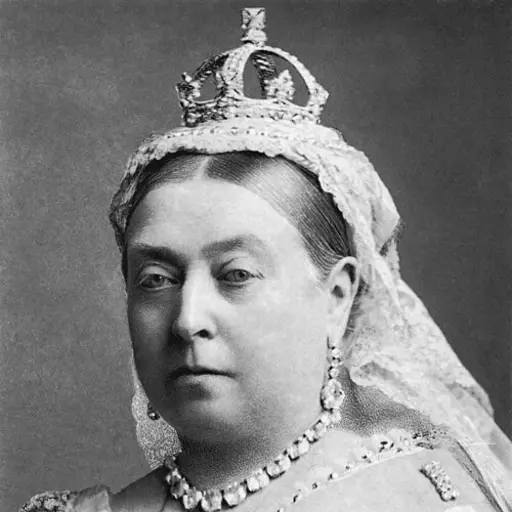

Reigned for 64 years, witnessing the global expansion of the British Empire.
Life
Unexpected succession
Victoria was born at Kensington Palace, London, a granddaughter of George III of the Hanoverian dynasty. At eighteen she unexpectedly succeeded to the throne because none of her uncles had legitimate heirs. When she came to the throne, reform of the British Parliament had only just begun, real royal power had already largely passed to the cabinet, and the crown's role was shifting from ruler to national symbol.
Imperial heyday
Her marriage to her cousin Prince Albert shaped the family image of the Victorian era, and together they championed the Great Exhibition of 1851. Her reign saw the height of the Industrial Revolution and the alternation of two parties in Parliament, while the empire expanded across India, Africa and Australia. In 1876, at Disraeli's urging, she was proclaimed Empress of India, and the colonies reached their greatest extent.
Symbol of an age
She was cast as a model monarch, frugal, diligent and faithful to the constitution, and the term "Victorian era" became a byword for prosperity and conservative morals. But the colonial expansion of her reign also brought the bloody suppression of the Indian Rebellion and repeated famines; a considerable gap remains to this day between the narrative of the empire's "Golden Age" and the memories of suffering among colonized peoples.
Legacy
Victoria's reign of more than 60 years marked the zenith of Britain's industry, technology and overseas expansion, and the "Victorian era" became a byword for an age and a moral climate. As the monarch's real power steadily faded, she shaped a new role for the constitutional monarch as a symbol of the nation. But to people in the colonies, this period also meant conquest, repression and famine, and assessments of her and her era differ markedly between Britain itself and its former colonies.
Major works & achievements
- Reigned 63 years, the longest-reigning British monarch up to that time
- With Prince Albert, promoted the Great Exhibition
- Proclaimed Empress of India in 1876
- Her children married into many European royal families, earning her the title "grandmother of Europe"
Did you know? She is the second-longest-reigning British monarch, surpassed only by Elizabeth II.
Key dates
- 1837Succeeds to the British throne
- 1840Marries Prince Albert
- 1851Presides over the Great Exhibition
- 1861Prince Albert dies
- 1876Crowned Empress of India
- 1887Celebrates her Golden Jubilee
- 1897Celebrates her Diamond Jubilee
- 1901Died