Dmitri Mendeleev
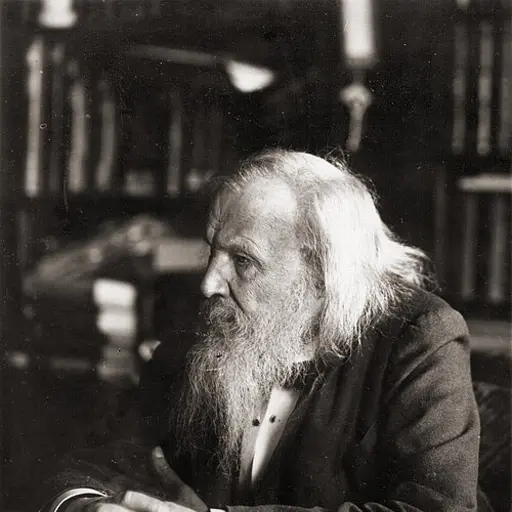

Compiled the periodic table of the elements and predicted the properties of unknown elements.
Life
Siberian boyhood
Mendeleev was born in Tobolsk, Siberia, the youngest child of his family; his mother sold off the family property to send him to study in Saint Petersburg. He later pursued further studies in Heidelberg, Germany, and after returning to Russia taught at Saint Petersburg University, where, while teaching inorganic chemistry, he was struck by how fragmented knowledge of the elements was and how it lacked a unified system.
Compiling the periodic table
In 1869 he arranged the more than sixty known elements by atomic weight and found that their properties recurred periodically, compiling the periodic table. He boldly left gaps and predicted the atomic weights and properties of elements yet to be discovered; later discoveries matched his predictions closely, bringing the periodic law wide acceptance.
Later years and the Nobel
The periodic table became the cornerstone of modern chemistry teaching, but in his later years he lost his post at Saint Petersburg University because of his conservative politics and opposition to the student movement, and he never received the Nobel Prize, which scholars generally attribute to personal grudges on the prize committee; it is regarded as one of the controversies in Nobel history.
Legacy
Mendeleev's periodic law integrated scattered knowledge of the elements into a unified system, and its success in predicting unknown elements proved its scientific value; the periodic table remains a basic tool of chemistry teaching and research to this day. Scholars also note that contemporaries such as Meyer independently proposed similar periodic arrangements, but Mendeleev's boldness in leaving gaps, correcting atomic weights and making specific predictions makes his contribution the most outstanding. Element 101, mendelevium, is named after him.
Major works & achievements
- Published the periodic law in 1869
- Predicted "eka-aluminium," "eka-boron" and "eka-silicon"
- Wrote the textbook Principles of Chemistry
- Headed Russia's Bureau of Weights and Measures
Did you know? Gallium, discovered in 1875, closely matched the properties he had predicted for "eka-aluminium," becoming strong evidence for the periodic law.
Key dates
- 1855Graduated from the Saint Petersburg Pedagogical Institute
- 1859Went to Heidelberg for further study
- 1865Became professor of Chemistry at Saint Petersburg University
- 1869Published the Periodic law
- 1871Predicted the properties of several unknown elements
- 1890Resigned his post for supporting a student movement
- 1907Died in Saint Petersburg