Lu Xun
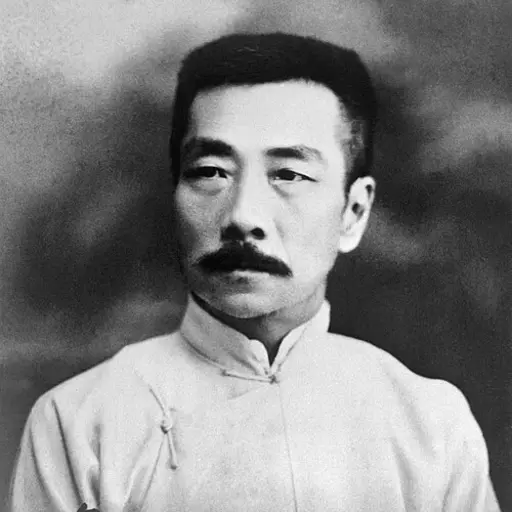

Criticized the national character in vernacular fiction and led the New Culture Movement.
Life
From medicine to literature
Lu Xun, born Zhou Shuren into a declining gentry family in Shaoxing, Zhejiang, went to Japan as a young man to study medicine. Deeply shaken after seeing a classroom lantern slide of Chinese people looking on as a compatriot was executed, he concluded that the spirit had to be cured first and turned from medicine to literature. After returning to China he worked at the Ministry of Education while also lecturing at universities.
Call to Arms and polemics
In 1918 he published the vernacular fiction "A Madman's Diary" in New Youth, shaking the literary world with its image of Confucian ritual morality as "cannibalism." He went on to write "The True Story of Ah Q," "Kong Yiji" and other works that dissected the numbness and self-deception in the national character, making him the most representative writer of the New Culture Movement. In his later years he actively supported the left-wing literature movement and was locked in constant polemics with many sides.
Soul of the nation
Official narratives revere him as the "standard-bearer of the New Culture Movement" and the "soul of the nation," and his works have long been a core part of Chinese-language education in schools. Some scholars point out, however, that his essays are heavily polemical and that his break with old friends late in life was tangled with personal grudges; turning him into an unquestionable, flawless idol has to some extent obscured the complex contradictions in his thought.
Legacy
Lu Xun was the founder of modern Chinese literature. His fiction dissected the national character and the old ethical code with a cold, incisive pen, marking the maturity of modern vernacular fiction; his essays became a powerful weapon for criticizing reality; and his A Brief History of Chinese Fiction was a pioneering work in the study of Chinese fiction. At his death his coffin was draped with a banner reading "Soul of the Nation," and he was long revered as the standard-bearer of the New Culture Movement. Scholarly research into his later polemics and the complexity of his thought has given a more rounded picture of him.
Major works & achievements
- Story collections Call to Arms and Wandering
- Novella The True Story of Ah Q
- Essay collection Dawn Blossoms Plucked at Dusk
- Prose-poetry collection Wild Grass
- Scholarly work A Brief History of Chinese Fiction
Did you know? "Lu Xun" was a pen name he first used in 1918, when he published "A Madman's Diary."
Key dates
- 1902Goes to Japan to study medicine
- 1906From medicine to literature
- 1912Works at the Ministry of Education
- 1918Publishes "A Madman's Diary"
- 1921Publishes "The True Story of Ah Q"
- 1927Settles in Shanghai and joins left-wing literature
- 1936Died of illness in Shanghai