Kang Youwei
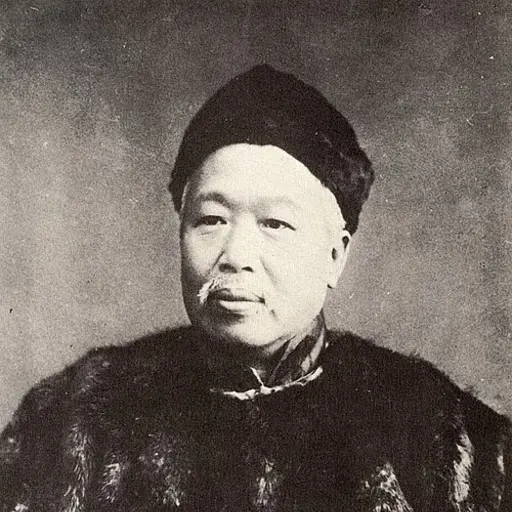

Launched the Petition of the Examination Candidates and led the Hundred Days' Reform.
Life
Scholar of Nanhai
Kang Youwei was born into a scholarly family in Nanhai, Guangdong. As a young man he read widely in the classics and histories and also encountered translated Western works, gradually forming his reformist idea of reforms in the name of antiquity. When news came of the defeat by Japan and the territorial cessions and indemnity of the Treaty of Shimonoseki, he joined with provincial candidates in Beijing for the metropolitan examination in a collective petition, known as the "Petition of the Examination Candidates," calling for rejecting the peace, moving the capital and carrying out reform.
Hundred Days' Reform
In 1898 he was received by the Guangxu Emperor and led the reforms known as the "Hundred Days' Reform," which included abolishing the eight-legged essay in favor of policy essays in the examinations, founding the Imperial University of Peking, streamlining government and encouraging industry. Empress Dowager Cixi and the conservatives swiftly staged a coup, imprisoned the Guangxu Emperor and executed Tan Sitong and the others of the "Six Gentlemen of the Hundred Days' Reform"; he and Liang Qichao fled to Japan, and the reform collapsed after just over a hundred days.
Royalism and restoration
He is seen as a forerunner of constitutional reform in modern China, but in exile he long clung to his royalist position and in 1917 even took part in Zhang Xun's farcical restoration of Puyi, in sharp contrast to his early reformist image. His classical-studies works advocating reform in the name of antiquity have also long been questioned for lacking scholarly rigor; these are the two controversies that no assessment of him can avoid.
Legacy
Kang Youwei was a leading figure of reformist thought in modern China. Drawing on New Text classical studies to justify reform, he drove the Hundred Days' Reform and had a profound influence on the intellectual liberation and constitutional movement of the late Qing, while his "Book of Great Unity" set out his social ideals. After going into exile, however, he remained a staunch monarchist opposed to the revolutionaries, and in 1917 he took part in Zhang Xun's Restoration, so his political image shifted dramatically. In scholarship, his judgments on the classics are considered arbitrary, but his role in challenging traditional authority is widely acknowledged.
Major works & achievements
- Led the "Petition of the Examination Candidates"
- Wrote "A Study of the Forged Classics of the Xin Period" and "A Study of Confucius as a Reformer"
- Led the Hundred Days' Reform
- Wrote the Book of Great Unity
- Founded the Protect the Emperor Society
Did you know? "Gongche" (public carriages) originally referred to the official carriages and horses that conveyed candidates for office in the Han dynasty; later it became a byword for provincial graduates going to the capital to sit the examinations.
Key dates
- 1888Submits his first memorial calling for reform
- 1895Launches the Petition of the Examination Candidates
- 1898Received by the emperor; launched the Hundred Days' Reform
- 1898Flees to Japan after the coup
- 1899Founds the Protect the Emperor Society in Canada
- 1917Takes part in Zhang Xun's Restoration
- 1927Died of illness in Qingdao