Otto von Bismarck
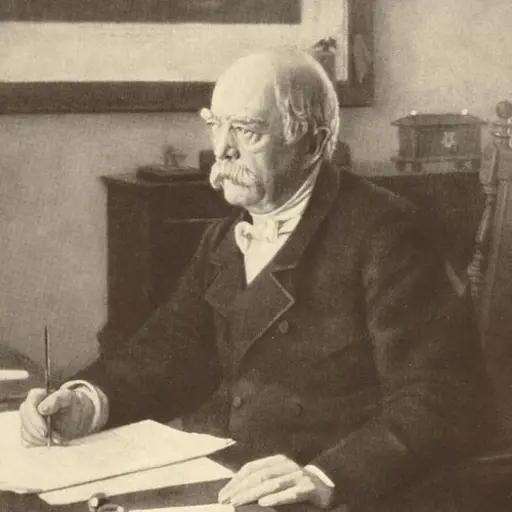

Brought about German unification by "iron and blood" and dominated the European diplomatic order.
Life
Iron Chancellor
Bismarck came from a Prussian Junker noble landowning family. He served as a diplomat early in his career and became Minister President of Prussia in 1862. Germany was then divided into more than thirty states and the unification movement had suffered repeated setbacks; in a speech to parliament he declared that the great questions of the day "will not be decided by speeches and majority resolutions, but by iron and blood."
Unifying Germany
He engineered three successive wars against Denmark, Austria and France, gradually excluding Austria and winning over the South German states. In 1871 he proclaimed the founding of the German Empire in the Hall of Mirrors at the Palace of Versailles and became its first Imperial Chancellor. He then built a European alliance system to isolate France, while at home he introduced social insurance and suppressed Catholicism and the Social Democratic Party.
Assessments
He is regarded as an exemplar of Realpolitik: his diplomatic alliance system kept the peace in Europe for decades, and his social insurance system was a precursor of the modern welfare state. Yet he single-handedly stifled parliament and party politics, and after him German diplomacy, no longer held in check, drifted toward confrontation; some historians believe this sowed the seeds of World War I.
Legacy
Bismarck achieved German unification by combining diplomacy and war, and is regarded as one of the most influential statesmen of the 19th century. He then maintained the European balance of power through a complex system of alliances and pioneered the modern social insurance system. Critics, however, argue that by unifying Germany through dynastic wars and the suppression of parliament he left German political culture favoring authority over democracy, and that his intricate diplomatic system depended too heavily on his personal management, so it could not be sustained after he left office.
Major works & achievements
- Completed German unification through three dynastic wars
- Founded the German Empire in 1871
- Built a continental alliance system to isolate France
- Created health, accident and old-age insurance
- Chaired the 1878 Congress of Berlin
Did you know? After he was dismissed by William II, the British magazine Punch published the famous cartoon "Dropping the Pilot."
Key dates
- 1862Became Minister President of Prussia
- 1864Wins war against Denmark
- 1866Defeats Austria in the Austro-Prussian War
- 1870Franco-Prussian War breaks out
- 1871German Empire founded; became chancellor
- 1878Enacts the Anti-Socialist Laws
- 1883Introduces health insurance and other social legislation
- 1890Dismissed by William II
- 1898Died