Emperor Wen of Sui
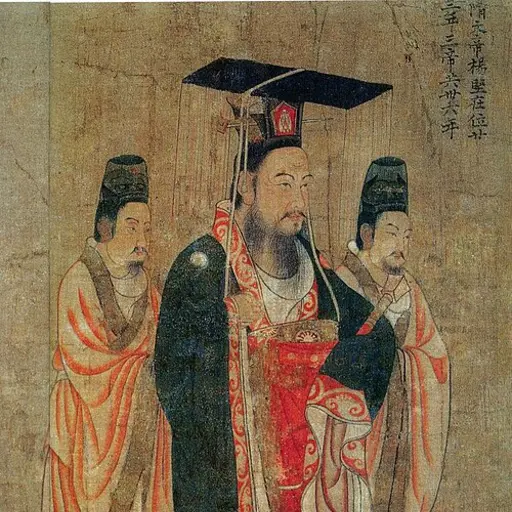

Ended the division of the Northern & Southern Dynasties, restored grand unification, and created the prototype of the Three Departments and Six Ministries.
Life
In-law of the Northern Zhou
Yang Jian came from the Yang clan of Hongnong and was an imperial in-law and senior minister of the Northern Zhou, controlling the Palace Army and the court. After Emperor Xuan of Northern Zhou died young, he acted as regent in his capacity as the maternal grandfather of the new ruler, soon deposed the child emperor, and in 581 CE replaced the Zhou as emperor, naming his state Sui and making Chang'an his capital. By then China had endured nearly three hundred years of north–south division and war.
Kaihuang reforms
After taking the throne he reorganized the bureaucracy, implemented the equal-field system and the zu-diao tax system, streamlined local administration, and set up a prototype of the Three Departments and Six Ministries to divide and balance power. He also began experimenting with selecting officials by examinations in separate subjects, laying the groundwork for the later imperial examination system. In 589 CE he sent troops across the Yangtze to conquer Chen, ending the long division that had lasted since the Western Jin and rebuilding a unified empire, and he vigorously built the city of Daxing and the Guangtong Canal.
Unification and hidden dangers
Later generations often link the brevity of the Sui dynasty to the tyranny of his son, Emperor Yang of Sui, and easily overlook the "Rule of Kaihuang" of Emperor Wen's own reign of more than twenty years, when the treasury overflowed and the registered population grew greatly. In his later years he grew suspicious of meritorious officials and deposed his eldest son in favor of a younger one, sowing the seeds of the Sui dynasty's rapid downfall, a point later often reduced to "the fault of Emperor Yang alone."
Legacy
Emperor Wen of Sui ended nearly three centuries of division dating from the end of the Western Jin and rebuilt a unified dynasty. Most of his institutions were inherited by the Tang dynasty, so historians say "the Tang continued the Sui system." He promoted frugality and the state granaries were full; the "Rule of Kaihuang" is regarded as one of the well-governed eras of Chinese history. But he was suspicious by nature and harsh in punishment, and late in life he deposed Crown Prince Yang Yong in favor of Yang Guang, sowing the seeds of the Sui's swift fall. The Sui is often compared with the Qin: both ended a period of division and laid institutional foundations, and both fell under their second emperor.
Major works & achievements
- Replaced Northern Zhou to found the Sui, crossed the Yangtze and conquered Chen to unify the country
- Established the Three Departments and Six Ministries
- Promulgated the Kaihuang Code
- Abolished the Nine-Rank System and pioneered selecting officials through examinations by category
- Built the city of Daxing and dug the Guangtong Canal
Did you know? According to the Book of Sui, he was born at the Prajna Temple in Fengyi and raised by the nun Zhixian, and his childhood name was "Naluoyan" (Narayana).
Key dates
- 581Replaced the Zhou as emperor and founded the Sui dynasty
- 583Promulgated the Kaihuang Code
- 587Abolished the Nine-rank system
- 589Conquered Chen and reunited north and south
- 598Ordered prefectures and counties to select officials by examination essays
- 604Died; the throne passed to Yang Guang