Adi Shankara
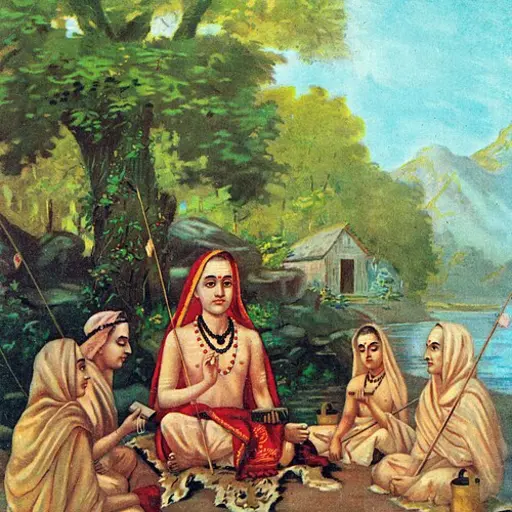

He systematically expounded Advaita Vedanta and founded monasteries in the four quarters of India to consolidate his school.
Life
Precocious youth became a monk
Adi Shankara was born into a Brahmin family in Kerala in southern India. Said to have been precocious as a child, he renounced the world as a monk while still young and studied Vedanta philosophy under a disciple of Gaudapada. He then traveled throughout India debating, renowned for his eloquence, and repeatedly defeated Buddhist and other rivals in public debate.
The Advaita system
He systematically expounded Advaita (non-dualism), holding that the individual soul (atman) and the cosmic absolute (Brahman) are ultimately not different, and that the phenomena of the world are merely illusory appearances. This doctrine gave Hinduism, then divided by philosophical disputes, a rigorous metaphysical system. To secure the transmission of his school, he founded monasteries in the east, west, south and north of India and organized the Dashanami monastic order, assigning his disciples to oversee each region.
Posthumous influence
Adi Shankara's Advaita Vedanta became the most influential branch of Hindu philosophy, and the monastic network he founded still operates today. Because he died young, few concrete biographical details survive from his short life of just over thirty years; many later stories about him, including the details of his debates with Buddhists and his founding of monasteries across India, largely come from embellished hagiographies by later followers and differ considerably from the reliable historical record.
Legacy
Adi Shankara is regarded as one of the most important philosophers in the history of Hindu thought. His Advaita Vedanta became the most influential school of later Indian philosophy and deeply influenced the religious reforms of modern figures such as Vivekananda. His commentaries on classics such as the Brahma Sutras remain foundational texts for the study of Vedanta. However, his dates are still debated: besides the common 788–820 CE there are earlier proposals, and many stories of his life come from later hagiographies.
Major works & achievements
- Systematically expounded Advaita Vedanta
- Wrote commentaries on the Brahma Sutras, the Bhagavad Gita and the Upanishads
- Traditionally said to have founded four monasteries in the four directions
- Organized the Dashanami Sangha
Key dates
- 788Born in Kalady, Kerala
- 800Became a Buddhist monk
- 805Traveled North India debating and teaching
- 810Established the Advaita system
- 814Founded four monasteries at the cardinal points
- 820Dies at just over thirty years of age