Euclid
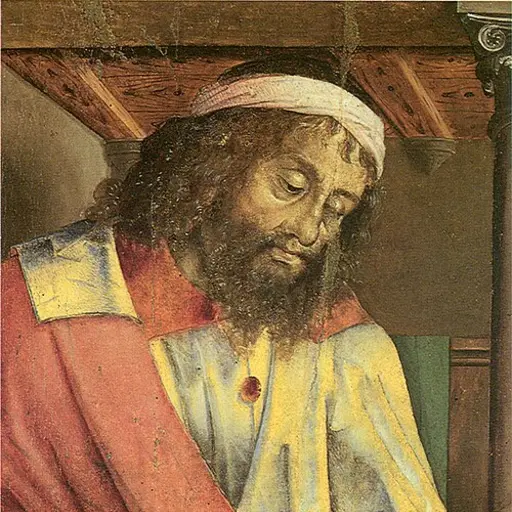

Compiled the Elements, establishing the tradition of axiomatic proof.
Life
Alexandrian scholar
Almost no record of Euclid's life survives; it is known only that he was active in Alexandria under Ptolemy I and may have studied at Plato's Academy in Athens. At that time the Mouseion of Alexandria had only recently been founded and drew together the scholars and books of the Mediterranean world, becoming the intellectual center of the Hellenistic period.
Elements
He organized the scattered results of earlier generations of Greek mathematicians into the Elements in thirteen books, deriving every proposition by strict logic from a small number of axioms and postulates and establishing a model of axiomatic proof that endured for more than two thousand years; its contents cover plane geometry, number theory and solid geometry.
Great synthesizer
Later generations often credited every theorem in the book to his own invention, but much of the content was inherited from predecessors such as the Pythagoreans and Eudoxus; Euclid's real contribution lay in systematic organization and rigorous logical structure. Scholars still debate whether he was a real individual or a collective name for the Alexandrian school.
Legacy
Euclid's Elements is one of the most widely used mathematics textbooks in the West; its method of deducing step by step from axioms became the model for argument in mathematics and indeed in science, influencing many thinkers from Arab scholars to Newton and Spinoza. The birth of non-Euclidean geometry in the 19th century grew directly out of mathematicians' long questioning of its fifth postulate (the parallel postulate). His own life, however, is almost a blank, and many of the results in the book were inherited from predecessors; his contribution lay chiefly in organizing and systematizing them.
Major works & achievements
- Elements in thirteen books
- Established a deductive system proceeding from axioms and postulates
- Proved there are infinitely many primes
- Also wrote Optics, Data and other works
Did you know? In the late Ming, Xu Guangqi and Matteo Ricci co-translated the first six books of Euclid's Elements, which established the Chinese word "jihe" for geometry.
Key dates
- 330 BCEBorn c. (life details unknown)
- 300 BCECompiled the Elements at the Mouseion of Alexandria
- 290 BCEEstablished the five postulates and the axiomatic method of proof
- 270 BCEHis school continued teaching in Alexandria
- 260 BCEDied c. (exact date unknown)