Gilgamesh
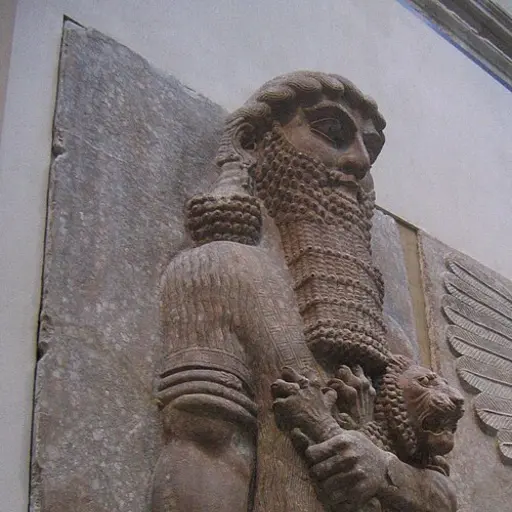

The King of Uruk in the Sumerian epic, who sought immortality but remained mortal in the end.
Life
Tyrant and friend
According to the Sumerian King List, Gilgamesh was the fifth king of Uruk. Legend holds that he was two-thirds god and one-third man and was notorious for his tyranny, until the gods created the wild man Enkidu to challenge him; instead the two became close friends and set out on adventures together.
Quest for immortality
The epic tells how the two went on an expedition to the Cedar Forest and slew its guardian monster Humbaba, then killed the Bull of Heaven, angering the gods, who caused Enkidu's death. Terrified of death after losing his close friend, Gilgamesh traveled far to seek out the flood survivor Utnapishtim and ask him the secret of eternal life, but through a moment's carelessness he lost the plant of immortality and was forced to accept that life is finite.
History and legend
Gilgamesh's identity as King of Uruk may have a real historical basis, but the epic's plot is a literary creation accumulated over later ages: the Sumerian short poems took shape around the 21st century BCE, the Old Babylonian version was fixed around the 18th century BCE, and the standard Assyrian version in common use was not finally compiled until sometime between the 12th and 7th centuries BCE. Themes such as the quest for immortality were mostly later additions, and the work was not written all at once in a single period.
Legacy
The Epic of Gilgamesh is often called one of the oldest surviving long works of literature in the world. It revolves around friendship, death and the meaning of life, and the similarity of its flood narrative to the biblical story of Noah's Ark has prompted a great deal of comparative study. As a historical figure, he may have been a real monarch of Uruk in the Early Dynastic period, though proof is lacking; as a literary figure, he embodies humanity's universal questioning in the face of death.
Major works & achievements
- Protagonist of the Epic of Gilgamesh
- Slays Humbaba with Enkidu
- Sought out the flood survivor in search of immortality
- Said to have built the walls of Uruk
Did you know? In 1872 George Smith deciphered the tablet of the epic that recounts a flood; its plot closely resembles the story of Noah's Ark, and the discovery caused a sensation.
Key dates
- 2700 BCEKing of Uruk according to the Sumerian King List (c.)
- 2100 BCEThe earliest surviving manuscripts of the Sumerian poems are produced
- 1800 BCEOld Babylonian version of the epic takes shape
- 1200 BCEStandard Assyrian version largely compiled
- 612 BCEClay tablets kept in the Nineveh library survive to this day