Fang Xiaoru
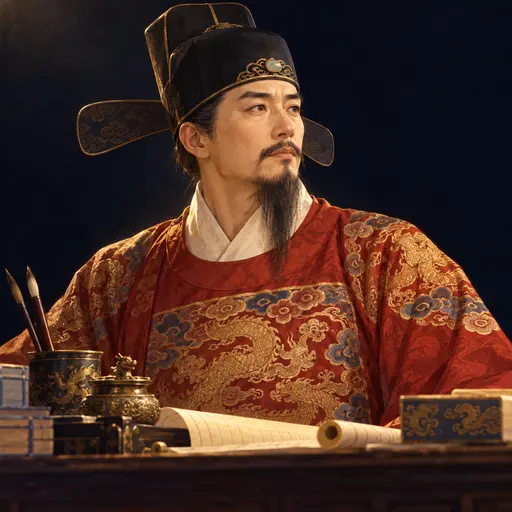
Refused to draft Zhu Di's accession edict and was killed.
Life
Master Zhengxue
Fang Xiaoru, from Ninghai, Zhejiang, studied under Song Lian and was renowned for his prose and Neo-Confucian learning, styling himself "Master Zhengxue." After the Jianwen Emperor took the throne, he summoned Fang as a Hanlin lecturer and relied on him as a confidant; many of the government's decrees and edicts came from his hand, and he helped push the reforms to curb the fiefs and restore the rites of Zhou.
Jianwen's Confidant
During the Jingnan Campaign he drafted most of the proclamations denouncing the Prince of Yan. When Zhu Di stormed Nanjing in 1402 and ordered him to draft the accession edict, he appeared in mourning clothes, wept loudly before the court, and wrote four characters on the paper: "The Yan Bandit Usurped the Throne."
"The Yan Bandit Usurped the Throne"
Enraged, Zhu Di had him dismembered outside Jubao Gate and extended the punishment to his relatives and protégés; many died, and the story of the "execution of ten degrees of kin" spread among the people. He was rehabilitated in the late Ming dynasty, and his tomb still stands at Yuhuatai in Nanjing.
Legacy
Fang Xiaoru is seen as the most extreme example of the loyal minister; later judgments of his "dying for his principles" range from admiration to charges of pedantry. The "Execution of Ten Degrees of Kin" is not clearly recorded in the official histories and may be a later exaggeration.
Major works & achievements
- Drafted edicts for the Jianwen court
- Wrote Collected Works of the Xunzhi Studio
Did you know? His collected works, the Xunzhizhai Collection, were banned under the Yongle Emperor, and anyone caught keeping a copy was punished; they were not reprinted until the late Ming.
Key dates
- 1376Studied under Song Lian
- 1399Summoned by the Jianwen Emperor as Hanlin Reader
- 1399Drafted the proclamation against the Prince of Yan
- 1402Refused to draft the accession edict; killed